




If you’ve stepped outside recently in South Central Pennsylvania, you’ve probably noticed the hazy skies and smelled the lingering scent of wildfire smoke.
While we do our best to protect ourselves indoors, have you thought about how that smoky air is affecting your Chevrolet?
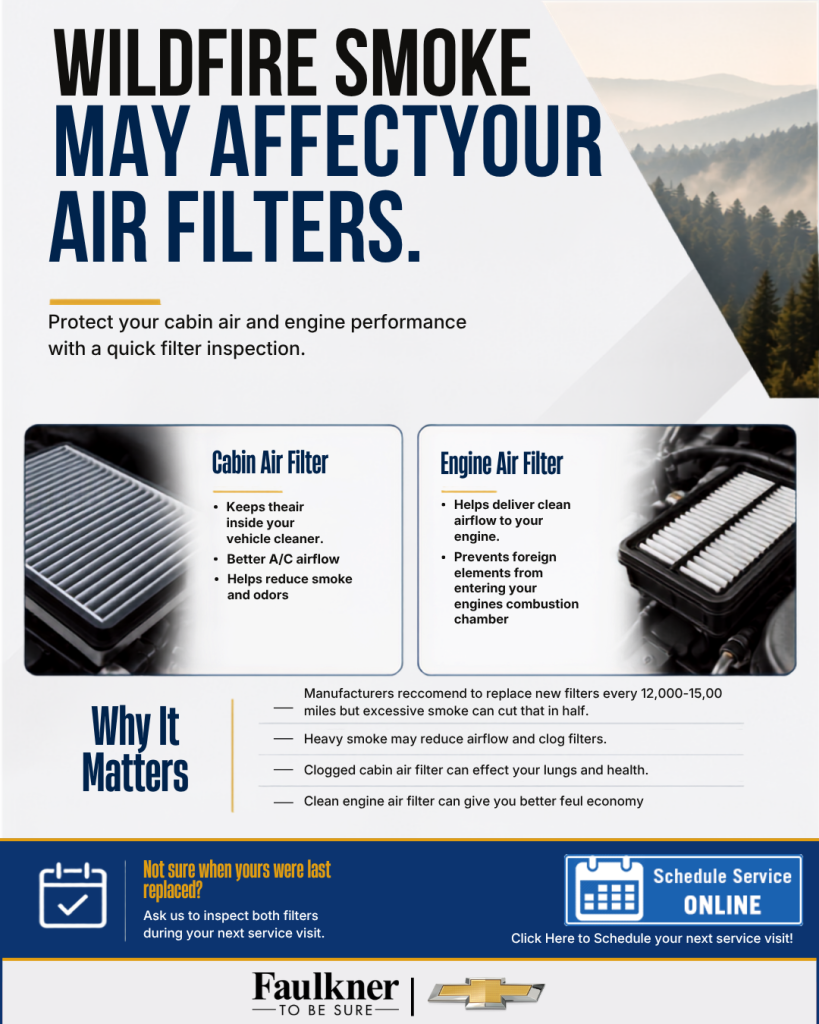
Your vehicle relies on two critical shields to block out airborne debris, soot, and ash:
- The Cabin Air Filter: Your car’s personal “face mask.” It cleans the air blowing through your heater and air conditioning vents before you and your passengers breathe it in.
- The Engine Air Filter: Your engine’s lungs. It prevents dirt, dust, and smoke particles from entering your engine’s combustion chamber, keeping your Chevy running smoothly.
Top 5 Reasons to Replace Your Filters After Wildfire Smoke
- 1. Smoke particles are incredibly microscopic: Wildfire smoke contains fine particulate matter (PM2.5) that easily gets wedged deep inside the pleats of your filters. Once saturated, the filter loses its ability to capture new particles, letting soot and odors bypass the system entirely.
- 2. Protect your health (and your passengers’ lungs): A clogged cabin air filter will circulate stagnant, ash-laden air throughout your vehicle. Changing it out guarantees you are breathing clean, purified oxygen inside your cabin—especially crucial for children, seniors, or anyone with seasonal allergies or respiratory sensitivities.
- 3. Revitalize your AC system’s airflow: When your cabin filter is caked with ash and soot, your air conditioning system has to work twice as hard to push air into the vehicle. Replacing the filter immediately restores strong, cool, and crisp airflow.
- 4. Maximize your fuel economy: A choked engine air filter restricts the oxygen your engine needs to burn fuel efficiently. By restoring proper airflow to the engine, your Chevy doesn’t have to burn extra fuel to maintain your usual highway performance.
- 5. Prevent long-term engine wear: If an engine filter is completely blocked, microscopic abrasive particles can bypass the seal and scrape against cylinder walls and pistons. A simple, inexpensive filter swap protects your engine from premature wear and tear.
When was the last time yours were replaced?
Most manufacturers recommend swapping both filters every 12,000 to 15,000 miles—but heavy smoke, pollen, and dust seasons can cut that lifespan in half. If you can’t remember the last time they were checked, it’s highly likely they are ready for a quick look.
At Faulkner Chevrolet of Lancaster, we can inspect both of your filters in just a couple of minutes during your next service visit. If they’re clean, we’ll leave them be. If they’re clogged with local PA soot, we can swap them out quickly with genuine ACDelco parts designed specifically for your Chevy model.
👉 Click Here to Schedule Your Filter Inspection & Service
Drive safe and breathe easy,
Connect with us

- July 2026
- December 2025
- August 2025
- June 2025
- April 2025
- March 2025
- December 2024
- November 2024
- October 2024
- August 2024
- June 2024
- February 2024
- December 2023
- September 2023
- August 2023
- November 2022
- February 2022
- December 2021
- July 2021
- March 2021
- January 2021
- December 2020
- November 2020
- October 2020
- September 2020
- August 2020
- July 2020